
Introduction
What exactly are you looking for when a pentest is conducted? If you’re new to the cybersecurity space and you’re looking to use pentest-as-a-service, you might be hoping for a completely clean report. No vulnerabilities, no critical findings.
This might even be what you’re used to if you’ve done some security testing of your own, or if previous pentesters have returned minimal results. But actually, what you’re looking for during a pentest isn’t necessarily a clean report – it’s the opposite.
The Reality of Security Risks in 2026
It’s very unlikely, for instance, that your organisation is completely free of vulnerabilities. Modern systems are simply too complex for that to be realistic.
Indeed, most organisations in 2026 rely on a mix of internally developed software, open-source components, third-party services, cloud infrastructure, APIs, identity providers, and more – each of which introduces a range of potential weaknesses that can be exploited by attackers.
What’s more, since each evolves over time as new features are deployed and configurations are changed, there are always new variables and potential misconfigurations emerging, meaning even the most well-maintained environments can accumulate risk as time goes by.
Finding Vulnerabilities Through Pentesting
With this in mind, it’s important to note that vulnerabilities don’t necessarily appear because something is ‘broken’, but because systems are interacting in unexpected ways. A small misconfiguration in one service might not seem significant on its own, but when combined with another weakness, it can form a viable attack path – and that’s exactly what pentests are designed for.
A thorough penetration test doesn’t necessarily check for individual technical flaws, but how different parts of a system behave together, whether that be through authentication flows, user roles, integrations, or edge cases to see whether assumptions about security actually hold up in the real world.
Let’s say, for instance, you’re using our pentest-as-a-service, with an automated pentest report to document and track the vulnerabilities uncovered. A tester might first discover a relatively minor issue, such as a user being able to access slightly more information from an API endpoint than intended.
On its own, that might look like a low-severity risk, but during deeper testing, the pentester could combine that issue with another weakness – perhaps a misconfigured permission rule or an overlooked role within the authentication system.
Then bang. When chained together, these seemingly minor issues suddenly allow an attacker to access sensitive data or escalate privileges within the application, potentially leading to a broader system compromise that completely destabilises your company.
How Clean Reports Reveal Testing Gaps
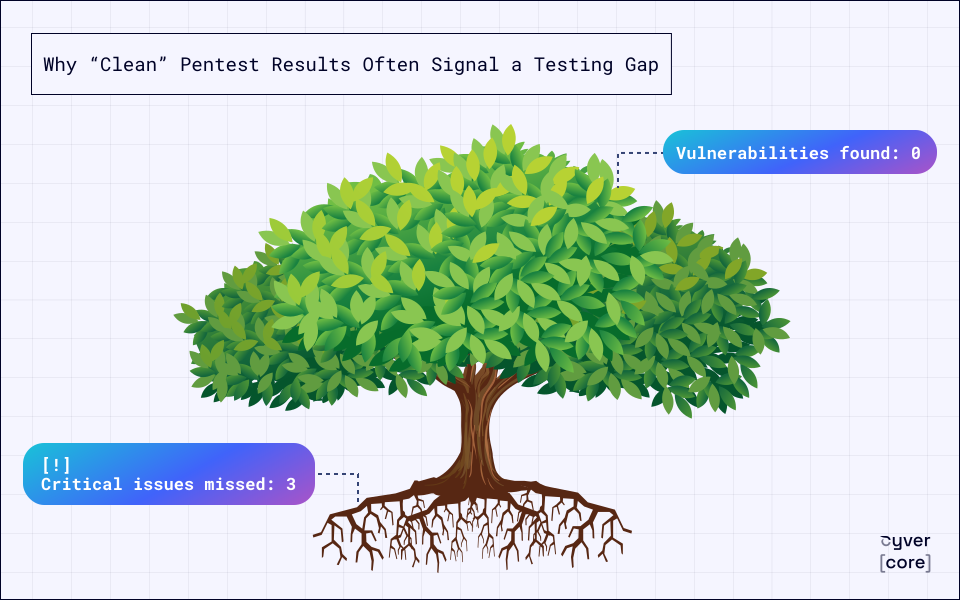
You only know this because the pentest is thorough, and you have a clear line-of-sight through the automated report that documents how each vulnerability connects. But what if you don’t have that? What if you’ve conducted a test that comes back with clean results, indicating that no vulnerabilities were discovered and there’s no way for attackers to breach the system?
Well, as we mentioned before, it’s unlikely – and that means it’s unreliable. In most cases, a ‘clean’ pentest report is more of a reflection on the report itself than the system it’s testing, indicating that there’s something wrong with the process that has made it harder to uncover vulnerabilities and report them in a way that makes sense.
Perhaps the scope is too narrow, or the testing time too short. Perhaps the methodology relied too heavily on automated scanning without deeper manual exploration, or testers weren’t given access to all relevant environments and integrations.
Pentesting works best when testers are able to probe assumptions and investigate how systems behave under unusual circumstances, and if those opportunities are restricted – or, even worse, the testing is treated as a compliance checkbox – important vulnerabilities can remain hidden simply because no one had the chance to uncover them.
Conclusion
The result for you is a report that offers no meaningful insights for your organisation. Sure, it might feel reassuring to have a clean report that fills you with confidence, but that confidence is ultimately misplaced, and it won’t help you when a real attacker identifies weaknesses and your organisation is under threat.
That’s why every organisation should treat clean pentest results with a degree of caution. Rather than assuming everything is secure, it’s worth looking at the test itself and where the gaps might be.
How deep did the testing actually go? How many attack paths were explored? Did testers examine how vulnerabilities might chain together? These are the questions that need to be asked to identify the gaps in the testing process, and if the answer to any of them is uncertain, it’s crucial to look for an alternative.
As mentioned above, we’ve worked hard to deliver a pentest-as-a-service platform that combines automated scanning with expert manual testing, complete with a streamlined remediation workflow to go from findings to fixes. It might not be immediately reassuring, but it’s this kind of realistic, thorough testing that you need if you want your organisation to remain strong, and your confidence in security to be well-founded.