
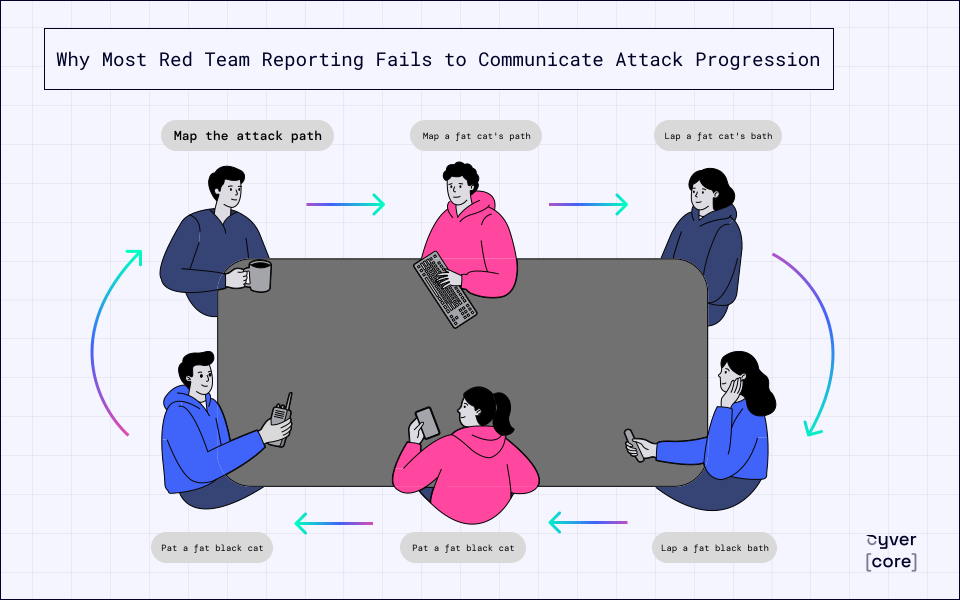
Conducting realistic attack simulations is hard enough to execute without having to manage an abundance of administrative tasks.
As a practice focused on simulating realistic adversary behavior and testing defensive capabilities, a whole lot of attention needs to be placed on planning attack scenarios and analyzing how an attacker could move through an environment.
With attacking techniques getting more complex themselves, this needs to be accurate, razor-sharp, otherwise a client will not truly know how their security posture is truly holding up against real-world threats.
The challenging thing when red teaming, however, is that the success of these exercises depends on far more than identifying weaknesses. It depends on understanding how individual attack techniques connect, documenting the full attack path, and communicating actionable insights that actually help clients improve their cybersecurity.
But the problem is that most red team reporting fails the latter point, meaning they put all the work into executing sophisticated attack simulations, only to struggle translating those findings into clear intelligence.
Communicating Attack Progression
During a red team engagement, attack progression is typically communicated through a combination of notes, evidence collection, and structured reporting.
As the exercise develops, operators document the techniques used, the systems accessed, the actions performed, the outcomes achieved, and the sequence of how an adversary moved from initial access through to their final objective.
In many cases, this involves mapping activity against established frameworks – such as MITRE ATT&CK or the Cyber Kill Chain – allowing teams to categorize the behaviors observed and provide additional context.
Screenshots, logs, and other evidence are collected too, and once the exercise is complete, all the information is consolidated into a final, comprehensive report.
The goal is to give the client total visibility into not only what was compromised, but how the compromise occurred and how bad the damage was. From this, they can then recognize where opportunities exist to strengthen their defences and ensure they’re not part of the next major cybercrime statistic.
The Problem With This
If you haven’t recognized an issue with the above process, it’s likely you’re following the same approach – and that’s an issue in its own right.
It isn’t that documenting attack progression is unnecessary – in fact, it’s one of the most important parts of a red team engagement. But it’s that many teams rely on this collection of disconnected methods to capture the information, meaning the attack story itself can become difficult to maintain as the engagement grows more complex.
A red team exercise rarely follows a perfectly linear path, after all. Attackers adapt, change direction, revisit previous steps, combine multiple techniques into one campaign. With this in mind, one action might rely on evidence collected several stages earlier, while another might only make sense when viewed alongside activity from a completely different part of the engagement altogether.
When this information exists in separate notes, documents, screenshots, and tools, maintaining the complete picture of the attack chain becomes increasingly difficult.
This creates a challenge, because the value of a red team exercise doesn’t come from individual actions in isolation. A compromised credential, a successful phishing attempt, or a system takeover only tells part of the story. The real insight comes from understanding how these events connect together to form a realistic attack path, and why existing security failed to prevent or detect that progression.
It’s a problem, too, because many engagements are becoming more complex. Even for small red teams focused on smaller objectives, because so many organizations have adopted more cloud services – including remote working infrastructure and APIs – the process often involves multiple attack paths and pretty sophisticated techniques.
If the engagement is more complex, the act of accurately and comprehensively reporting it is more complex too, and this puts these teams even further on the back foot.
Communicating Attack Progression Effectively
This is the reason why so many red teams are now using structured platforms to manage their engagements. By bringing attack paths, evidence, techniques, and outcomes into a single workflow, teams can maintain a far clearer view of how an engagement develops from start to finish.
With this clearer view, they can then understand the full attack chain, ensuring they know how individual actions connect and how specific techniques contribute to the wider objective. The important thing in all of this is to avoid fragmentation and make things plain and simple.
So, instead of scattered notes and separate documents, fragmented evidence and isolated data, red teams have a way to centralize their findings and maintain a connected record of the entire picture.
From there, they can be sure that they communicate the attack narrative in a clear and understandable format, and the client is completely aware of what the issues are and how to fix them.
It might seem like a small thing, but if the reporting process is disconnected, there’s every chance important context can be missed. Even worse than this, attack paths can be misunderstood, and since the cybersecurity landscape is becoming more dangerous, as we mentioned earlier, gaps like this simply cannot be afforded.
Better organization means better visibility, and better visibility means a better chance of communicating everything clearly, and finishing the job in the right way.