
CVSS scores are perhaps the most important part of a pentest report, giving teams a standardised way to understand the severity of vulnerabilities they uncover and prioritise remediation efforts.
But they need to be consistent. With so much change in applications, networks, and threat landscapes, every security-conscious company needs to have comprehensive, accurate security metrics in order to understand its positioning in the cybersecurity space.
Are they continuously improving, or are they falling behind their risk tolerance? These security metrics build a historical record over time, giving organisations a clear picture of their overall security posture that can be helpful when pentests are repeated.
So what if, somewhere along the line, they go wrong? What if ratings become inconsistent and key vulnerabilities are missed? The result is an organisation without true visibility, and it all comes back to risk scoring and getting the fundamental evaluation criteria correct consistently.
Inconsistent Risk Scoring
One of the most useful features in our pentest reporting platform is our vulnerability management and insights dashboards, offering automated risk scores combined with contextual data to produce more meaningful metrics that align with actual real-world risk.
It might sound a little odd saying that, seeing as CVSS scores are designed to standardise vulnerability severity, but the thing is, they’re never completely objective. Two ‘high’ CVSS scores can mean different things, perhaps because they’re derived from different attack vectors, or affect assets with varying criticality.
Without additional contextualisation, it’s far harder to interpret the severity of each finding and make longitudinal reports truly actionable.
Drifting Risk Metrics
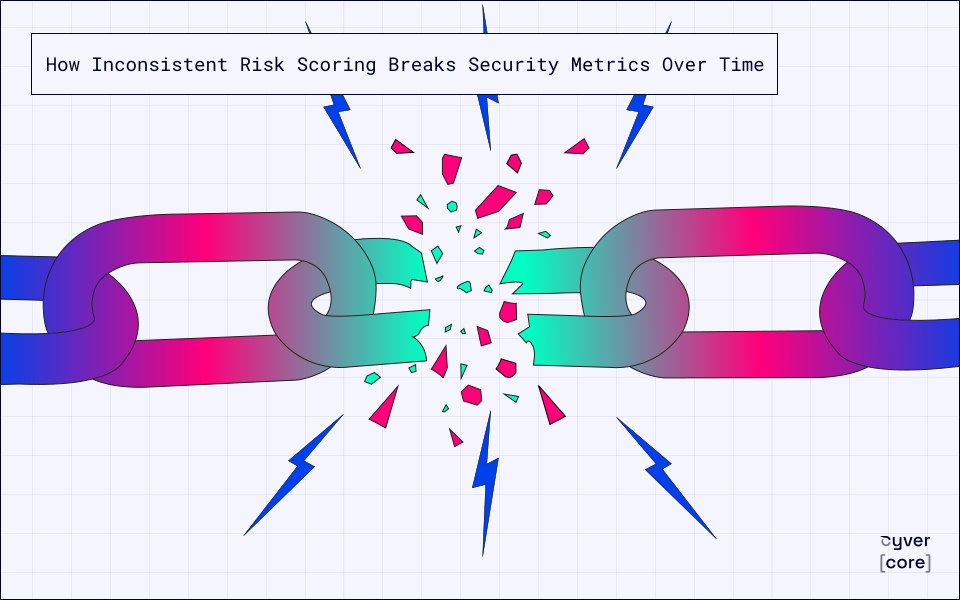
This is where risk metrics can begin to drift – one assessor might mark a vulnerability as high risk in one test and medium in another, or a scan today can show different priority levels than a scan next month, making trend analysis virtually meaningless. The result is a broken security metric system and three key consequences:
- Misaligned Remediation Priorities
- Wasted Resources
- False Sense of Security
In terms of misaligned remediation priorities, this would come about from the fact that high-impact vulnerabilities are appearing less urgent than they truly are.
For example, a vulnerability affecting a critical database might be scored lower because the automated tool doesn’t fully account for the way that database interacts with other key systems, or the potential for chained exploits that could escalate a seemingly minor issue into a major breach.
Instead of focusing on these vulnerabilities, teams might be spending their time patching what are actually superficial issues – minor configuration errors, outdated software warnings, or cosmetic misconfigurations that don’t need to be acted upon until after the more complex, multi-step attack paths have been addressed.
This leads on to the second consequence: wasted resources. When teams spend time and effort fixing vulnerabilities that are artificially inflated in severity – or duplicating work across assessments – they divert their cybersecurity capacity away from the areas that actually matter.
Not only this, but operational costs are directly affected, with teams spending hours – or even days – on low-priority patches and unnecessary validation cycles. Increased retesting and manual verification increase labour costs, which would be fine if the work being done is actually reducing real-world risk.
But with inconsistent risk scoring – and broken security metrics – this cannot be guaranteed, and that’s a huge issue for organisations looking for measurable security improvements and effective allocation of resources across the board.
Lastly, and perhaps most damagingly, organisations can easily gain a false sense of security. If security metrics have gone wrong over time, what’s effectively happening is that a company is steadily losing true visibility into its own attack surface. It believes it’s protected when critical gaps remain unaddressed, and that’s only making it more vulnerable for when real-world exploits or new sophisticated cyberattacks eventually arise – which, in the current cybersecurity landscape, is becoming more of an inevitability than hypothetical.
Accurate Risk Scoring
Again, though, this only happens when risk scoring is inconsistent – or in other words, reliant solely on CVSS in isolation. With a centralised, structured platform – including features like an integrated CVSS calculator and asset-aware prioritisation – teams can view vulnerabilities in the context of their business impact and asset criticality, allowing remediation to be far more intelligent and efficiently tracked.
What’s more, automation is a key part of the process, with risk scores updated as fixes are applied or new information emerges. The reason this is important is because it allows teams to see how their overall exposure evolves without allocating heavy resources to low-priority issues, staying aligned with their actual attack surface while maintaining an accurate historical record of risk reduction over time.
Human oversight is still needed, of course – it’s never wise to allow automation to handle all the heavy lifting when it comes to interpreting risk. But with context, analyst review, and intelligent algorithms, risk scoring can become far more business-oriented and consistent, and this is only a positive when it comes to the ongoing stability and reliability of your overall security metrics.