
Introduction
Security tests are the line of defence between your company and the world of cyber threats. It’s hard to believe that one in five companies still don’t test their software for security vulnerabilities.
There are many reasons why this might be the case – including complacency and hubris – but one of the most significant is the difficulty in standardising security test reports across a distributed team, and ensuring consistent communication.
If you have a distributed security team, it can be difficult to maintain uniformity in reporting, tracking vulnerabilities efficiently, and providing clear, actionable guidance across locations. But that’s where pentest reporting tools have become so useful in the cybersecurity landscape.
Standardisation Through Pentesting Tools
As a pentest reporting platform that helps with centralising findings and streamlining report generation, we know the importance of creating consistent, actionable, and easily understandable reports across a wide network.
As cyber threats grow more frequent and security teams grow denser, automated reporting has become the key to ensuring critical vulnerabilities are communicated and addressed quickly, and the reason for this is simple.
Manual reporting is slow, inconsistent, and prone to errors, hence why a large portion of businesses don’t do it. Automated reporting, on the other hand, offers the speed and consistency that can make the process both reliable and scalable.
How to Standardise Security Tests
In terms of how to achieve standardised security reporting, a platform like ours centralises all findings from multiple testers and tools into a single repository, ensuring that every vulnerability is documented in a clear and consistent manner. We also provide consistent pentest documentation, with pentest report templates that maintain formatting and severity ratings regardless of who performs the test or where they’re located.
Looking at the workflow and collaboration process itself, this can all be done directly within the platform, reducing the risk of information being lost or miscommunicated. This becomes even more important when considering how multi-location security teams are spread across different offices or time zones, making clarity and consistency far more challenging than if they were in a single centralised space.
What’s more, we also provide a unified reporting framework, which means that every test follows the same structure and terminology, ensuring reports remain consistent, and there’s no confused communication between team members.
Tracking Vulnerabilities Through Pentest Reporting Tools
Apart from security testing standardisation and distributed team reporting, there are other benefits to pentest reporting tools that shouldn’t be understated. Vulnerability management itself is one of the most significant. Yes, standardisation in reporting is important, but the reason you want to standardise your processes is to streamline vulnerability tracking, actively ensuring a business aligns with recognised security standards – such as the NIST cybersecurity framework – and is consistently safe.
On our platform, for instance, all findings from different testers and tools – including Burp, Nessus, and OpenVAS – are merged into a single repository, mapped to severity scores, and automatically turned into actionable tickets.
What does this mean? Essentially, it allows you to assign, track, and actually resolve vulnerabilities far more efficiently, reducing the risk of issues slipping through the cracks and giving both security teams and stakeholders clear visibility into the status of every finding. As well as this, it enables prioritisation based on severity and business impact.
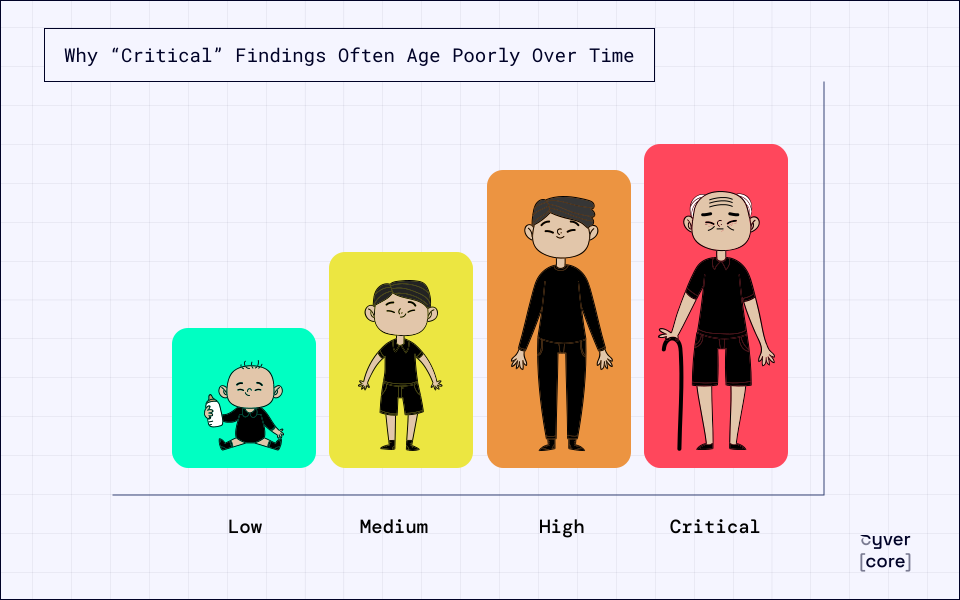
Let’s say your team discovers multiple vulnerabilities across several web applications during a pentest. With a standardised reporting platform, each vulnerability is automatically categorised by severity and mapped to the responsible system owner, meaning the most critical issues can be flagged and addressed before any of the others.
Meanwhile, lower-severity issues, like outdated software versions or minor misconfigurations, are scheduled for remediation in a more structured way, ensuring they’re not overlooked, but aren’t prioritised over the more critical vulnerabilities that can take the business down.
Conclusion
Having a distributed security team doesn’t mean you have to sacrifice consistency, clarity, or efficiency in your security testing and reporting. It also doesn’t mean that you have to spend a lot of time and money on manual report writing and consolidating findings.
With the right pentest reporting tools – including our custom report templates and Gen-AI copilot – you can centralise all findings and automate your workflows, ensuring that every vulnerability is tracked and addressed in a correct, efficient manner. All you have to do is realise the dangers of cyber threats and take the necessary steps to address them proactively.
Even if you’re running a small company, having a distributed security team doesn’t mean you have to be more vulnerable to cyber attacks. In all truth, you can’t afford to be. Just one attack can be enough to compromise your data and damage your reputation, so it’s your job to utilise a solution like ours and attain the benefits, allowing the platform to formulate those reports, assign the remediation tasks, and make security management simpler and more effective than ever for your team.