
Automation in the world of cybersecurity has become a core part of many modern strategies. From continuous vulnerability scanning to real-time network monitoring, automation has enabled organisations to identify and respond to threats at scale, but nowhere is this more impactful than in pentesting.
For those unaware, automated pentesting is the use of tools and platforms to scan applications and infrastructure for known vulnerabilities, simulating potential attack paths without the need for constant manual intervention, and providing reports and remediation guidance consistently and scalably.
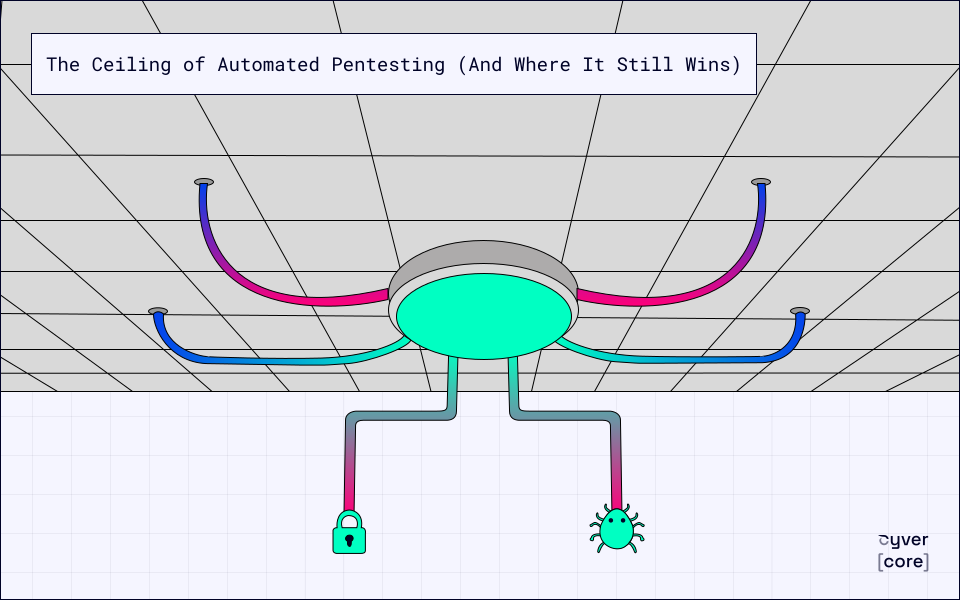
Over the last few years, it’s been refined to the point where organisations can run regular, repeatable tests with minimal effort, gaining fast and cohesive viability into their security posture. But there’s a catch. Or, rather, there’s a ceiling that automation alone cannot break through.
The Ceiling of Context
We’ll be the first to say that automating entire business processes – especially in the cybersecurity landscape, where depth of understanding can often win over speed – is never a good idea if you’re looking for comprehensive security.
Sure, automated pentesting tools are excellent at finding known vulnerabilities, running frequent tests, and covering large environments quickly, but there will always be a point where automation stops and human expertise should begin. That ceiling identifies itself, first and foremost, as a lack of business context. Even when using an automated pentest platform, a specific business isn’t going to be factored into the testing logic.
Automated tools don’t understand completely – and we’re talking about the entire spectrum, from user behaviour to application workflows and trust boundaries – how an application or network is intended to be used, what assets are most critical, or how an attacker might realistically move through an environment to achieve a meaningful objective.
They can systemically identify known vulnerabilities and misconfigurations, which is part of the reason why they’re so beneficial for continuous scanning and maintaining baseline security hygiene, but you can’t rely on them to completely understand business logic vulnerabilities. Issues like privilege escalation through intended functionality, abuse of workflows, chaining low-severity findings into a critical exploit. All of these require a level of creativity and contextual awareness that automation simply cannot replicate.
The Ceiling of Validation
There’s also the question of validation. One of the most useful things about AI in pentest reporting is that it can generate huge volumes of findings, along with vulnerability summaries and human-readable explanations of complex issues – but the key word here is ‘human-readable’. Without human verification, teams can easily find themselves chasing false positives or missing the true impact of a vulnerability.
But this needs to be on the human side due to the reason we mentioned above: automated platforms are excellent at flagging patterns, but they can’t always determine how these issues interact with a specific environment or business processes. To give an example, let’s say an automated pentesting tool flags a misconfigured API endpoint.
When looked at in isolation, this might appear low-risk and routine, but when combined with other factors – such as user permissions, workflow dependencies, or third-party integrations – it could quickly become a high-severity attack vector, potentially risking the exposure of sensitive data or allowing lateral movement across a network.
Only a human tester can evaluate this kind of nuance and decide which findings require the most careful attention, and if that tester isn’t there, and an organisation relies solely on automation, it’s likely that some serious risks will be underestimated.
The Ceiling of Creativity
Creativity should similarly be noted. If an organisation really wants to uncover complex attack paths, it needs skilled testers who can think like an attacker and adapt strategies as testing progresses.
It’s also worth noting how a human perspective is needed after the reporting is done. An automated tool can gather reports and highlight key issues, of course, but once that is done, it’s up to the organisation itself to decide what to do with them.
Is there a misconfigured API that needs to be immediately patched, or can it be mitigated and monitored while a full fix is developed? Should a low-severity workflow vulnerability be scheduled for a future release, or does it need urgent attention due to it being chained into a more serious exploit?
Understand, prioritise, remediate. Those are the three critical steps that maximise the usefulness of automated pentesting, but are entirely driven by a human perspective – a perspective that is shaped by contextual understanding, and guided by knowledge of the organisation’s priorities and critical assets.
Conclusion
Make no mistake, automated pentesting still wins at speed, coverage, and consistency. But the point is, it needs to be coupled cohesively with human expertise to really make the most out of it.
On its own, there’s a clear ceiling which can leave nuanced vulnerabilities undetected and business logic flaws untested. Alongside human insight and creativity, the possibilities are endless, making an organisation’s cybersecurity more resilient and adaptive than ever.