
We often talk about red teaming as a way of improving cybersecurity, but what does this actually mean for the clients who commission these engagements?
It can’t be a simple question of cybersecurity awareness, since the reason clients hire red teams is to improve their security posture, meaning cybersecurity is already at the forefront of their mind. Nor can it be a question of compliance, since you don’t have to invest in attack simulations to satisfy regulatory requirements. So what does red team reporting actually give clients that makes it so valuable in 2026?
A Question of Visualization
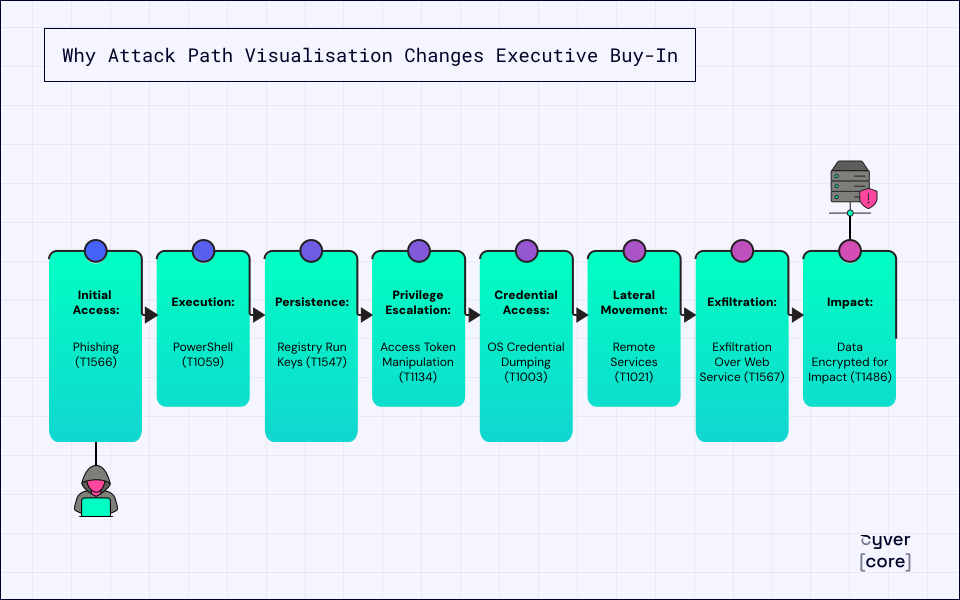
Really, it’s all about visualization. While clients might understand the threats they’re facing, they don’t necessarily understand how those attacks unfold and the path that attackers take. A red team engagement is about translating that information, connecting individual actions together and creating a clear picture of how an adversary could realistically progress through an environment.
For example, a red team might demonstrate how phishing led to access, or how a compromised account enabled lateral movement. In any case, the focus shifts from simply showing what was compromised – or what could be compromised – to explaining how that compromise happened.
This is important because real-world attacks rarely occur as isolated incidents. Attackers don’t exploit one vulnerability and immediately stop, they chain together multiple weaknesses and look for opportunities to move deeper into a network or system.
For this reason, a vulnerability that appears low-risk when viewed independently could easily become more significant when it forms part of a larger attack path, and a red team's job is to demonstrate that connection and work to visualize it. Through this visualization, a client can then understand the full context and see the wider impact of things that are not so obvious.
A Question of Context
To explain further, context has always been an important part of business. No matter the industry or sector, businesses need a way to focus their resources and understand where risks and opportunities exist, and in the realm of cybersecurity, this becomes even more crucial.
A business might not fix a vulnerability if they believe it’s an isolated issue with limited impact. If they put it in the context of a wider attack path, however, they’re far more likely to recognize its importance, understanding its position in the grander scheme of their security posture and overall risk exposure.
You might be asking at this point why visualization is needed for this, but again, it’s the context that makes the difference. Technical reports often contain detailed information that security teams need, but they can easily be difficult for non-technical stakeholders to interpret – which is a problem given that it’s these stakeholders that will ultimately make the decision on whether or not to allocate remediation resources.
An attack path provides a far more intuitive way to communicate risk, working to transform complex technical activity into a clear, actionable narrative: where the attacker started, what they achieved, and what could have happened if the exercise had been a real intrusion. From there, clients can act on this contextualized visualization to prioritize improvements and make the correct choices in their cybersecurity strategy.
Building a Security Picture
When we talk about changing executive buy-in, we’re not just referring to a point-in-time investment. Indeed, one of the most beneficial things about attack path visualization is that it helps to build a historical security picture. For organizations running vulnerability re-testing through repeated red team exercises, previous attacks effectively become a baseline – a reference point that highlights improvements and reveals emerging risks.
For example, while a previous exercise might show that attackers reached sensitive systems through credential stuffing, a later exercise might show that identity controls improved. In the same breath, it might show that those controls improved but that attackers found a different route through cloud permissions.
Over time, these visualizations then create a record of how organizational risk changes, and help clients to compare old attack routes with the new ones.
With that visibility and continuity in place, executive buy-in becomes less about reacting to individual findings and more about understanding the wider security journey – leaders can see where investments are actually reducing risk and where new challenges are emerging, and from there, they can maintain a continuous process of measuring and improving their threat resilience.
Conclusion
Ultimately, the value of a red team engagement is not just found in identifying whether an attacker could compromise a network. Because it’s a simulation of how an adversary would target an environment, the real value comes from helping an organization understand what that compromise would look like and what needs to be done to prevent it.
Without that context, even the most technically accurate findings can struggle to create meaningful action, but attack path visualization helps bridge the gap between technical evidence and business decision-making, and thus helps those businesses make more informed decisions about their long-term security strategy.