

In 2026, more and more companies are pentesting their applications. This is a good thing, of course – it demonstrates increased awareness amongst brands of the cybersecurity risks they face, and just how much of a threat they can be for their data and systems. But just because a company might pentest their app, doesn’t mean they’re doing everything in their power to fully protect it.
On the contrary, analysing an app’s security posture and identifying vulnerabilities cannot be done in a single test – it takes multiple analyses to gain a full understanding of how an application can be exploited, and how its attack surface can evolve over time. With this in mind, pentesting an app multiple times isn’t a wasted effort, it’s a critical step that could be the key to preventing serious security breaches.
Why Two Pentests of the Same App Rarely Produce the Same Results
So why is this the case? To understand why two pentests of the same application can uncover different insights, we have to consider what a pentest actually does. A penetration test isn’t a simple checklist or automated scan. It’s an assessment designed to simulate how a real attacker might think and behave.
While tools can support the process – whether that’s a pentest reporting platform or a CTEM tool – much of the value comes from the tester’s creativity, experience, and methodology. Just as every attack will be unique and unpredictable every pentest will never truly be identical, since different testers will approach the same application in different ways – and, in doing so, prioritise different areas.
To give an example, let’s say one tester focuses heavily on authentication flows – working to identify weaknesses in login mechanisms or access controls – another might spend more time probing business logic or chaining smaller issues into larger exploits. The result for an organisation is that every risk is covered and a more complete picture of the application’s security is built over time.
Timing as a Key Factor
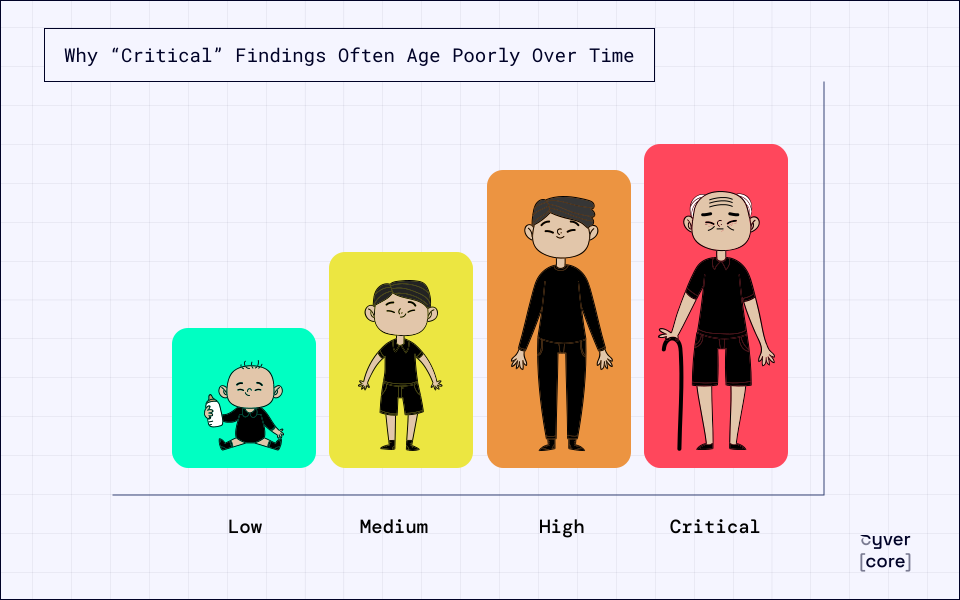
Timing also plays an important role. Applications are constantly evolving. A pentest from one year ago might not have the same relevance today, whether that’s because new features have been added, functionality has been updated, or dependencies and configurations have been patched or replaced. The point is, it’s a different application than it was before, and as such, vulnerabilities might have changed.
This means that even if the same app is tested twice in relatively short succession, the underlying codebase may not be exactly the same. A vulnerability that didn’t exist during the first test may be introduced in the next release, or a previously identified issue may have been fixed incorrectly, creating an entirely new attacking path.
The key point for teams is to recognise how risks evolve over time, running multiple tests, assessments, and even red teaming to identify newly introduced vulnerabilities and validate that previous issues have been properly remediated.
Beyond changes to the application itself, the wider threat landscape is also continuously shifting. In 2026, for instance, one of the main concerns for companies in the cybersecurity space is the introduction of AI-driven attacks and automated exploitation strategies – technologies and techniques that were not as much of a concern two years ago.
With new exploits, tech, and attack patterns being discovered all the time, what wasn’t considered a viable attack during one engagement may become a priority in the next, and that makes continuous security testing a crucial part of the protection process.
Environmental Considerations
Lastly, one of the most overlooked aspects of pentesting is the environmental considerations – the way in which an application behaves in different contexts and setups. For instance, an app might function perfectly in the staging environment – where test data is limited and security controls are less strict.
But due to differences in data, network architecture, user roles, third-party integrations, and more, issues can appear in production that were never visible before, creating new security gaps that only manifest under real-world conditions. Relying on a single test environment, therefore, only gives a false sense of security. In other words, the app you’re interacting with during testing is not necessarily what your users – and, more importantly, potential attackers – are going to see.
The reason you’re doing more than one pentest is because you’re accounting for how the application behaves across all relevant contexts, ensuring that findings reflect the risks users and attackers are realistically going to encounter. By considering these environmental variations, you’re gaining a far more accurate understanding of their exposure and, as such, can prioritise remediation efforts that truly reduce risk.
Conclusion
It’s very uncommon that two pentests of the same app will produce the same results, and just because the results aren’t identical, it doesn’t mean one test was more accurate than the other – or becomes null and void.
As an organisation, you want to make sure that every corner is covered, and every risk is addressed before it becomes an issue. Just as you would test a product or workflows again and again, an app’s security surface should receive the same treatment, giving you the assurance that the vulnerabilities are known and can be effectively remediated.